Rockets, satellites, planets and solar system explorations, dark matter and black holes. People, science projects, and telescopes discovering the universe.

Launcher
Home
Headlines - Space.com
IMO
ISS
Missions
NAMN
People
Rockets
Satellites
Science Projects
SETI
Solar System
Space Shuttle,
Spaceships

Space Tourism
Stars
Telescopes

NASA Centers
Centers List
Deep Space
Network
Education Sites
Field Centers
Goddard
HEDS: Space Flight
Johnson
Kennedy
Liftoff to Space
Marshall
NASAexplores
Origins Program
Organizations
R&T Reports
Science@NASA
SEDS
Space Camp
SpaceKids
Space Lab: NOAA
Space Library
SpaceLink
SpaceWeather.com
Stennis

Related:
British National Space
Canadian Space Agency
Chabot Space & Science
ISAS
ESA
Feedback
Free Update
Natural Science
Space Adventures
Space Explorers, Inc.
Submissions

Research Sites:
Ames
Calgary ISR
Dryden
DSRI
ESTEC
ETL
Glenn
Hiraiso Solar
Icing Tunnel
IKI
INPE
ISRO
JGR
Langley
MIT
New Wave
NSBRI
SPARC
Texas Space
University of Leicester
USRA
White Sands

For questions concerning this site, contact webmaster.


Find your favorite art:

printfinders.com

When space makes you dizzy:
Landing a spaceship is not a good time for a pilot to feel dizzy.

It's easy to tell which way is up and which way is down...or is it? In the freefall of space travel, there's no pull of gravity to tell your body which way is which. Most astronauts and cosmonauts experience some motion sickness when they first arrive in orbit. NASA is studying why.

Collectology - the collecting of science

Download sound files of the sun from Stanford's Solar Center: The Singing Sun.

Go to theBBC SPACE Science Homepage & Weather Page
for space events and forecasts.


Send an Internet Greeting Card
Enter Card ID Number to
Pickup Your Greeting Card


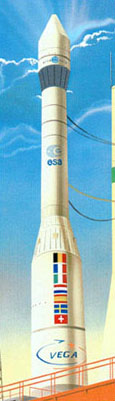
Vega - the Future from the ESA
 
 
Main Data Vega
Height 27 m
Diameter 3 m
Liftoff mass 128 tonnes
Payload mass* 1500 kg
 
Although there is a growing tendency for satellites to become larger, there is still a need for a small launcher to put 300 to 2000 kg satellites, for scientific and Earth observation missions, into polar and low-Earth orbits economically.

Europe’s answer to these needs is Vega, named after the 2nd brightest star in the northern hemisphere. Vega will make access to space easier, quicker and cheaper. Costs are being kept to a minimum by using some of the technologies already developed for Ariane launchers. Vega will also be able to make use of the existing launch facilities at Europe’s spaceport in Kourou.

Vega has been designed as a single body launcher with three solid propulsion stages and an additional liquid propulsion upper module for attitude and orbit control, and satellite release.

Development of the Vega launcher started in 1998 and the first launch is planned to take place in 2005.

* Launch in Circular Orbit, 90°inclination


Please visit our
affiliate partners that
keeps our site up.


Home   |   Free Update   |   Headlines - Space.com   |   Submissions   |   Contact Us
Copyright ©2001, 2002   SpaceHike.com.   All right reserved.
If you have questions concerning this website, contact webmaster@SpaceHike.com