Hot Spot Cosmic Accelerators
by the European Southern Observatory
More articles in TelescopesVLT Images Intergalactic Shock
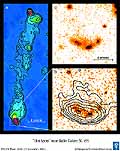
Caption: PR Photo 26/02 shows the particle jets from the radio galaxy 3C445, as observed with the NRAO Very Large Array (VLA) radio facility ("a"; left) and with the ESO Very Large Telescope (VLT) optical/IR facility ("b" and "c"; right). Two plasma jets of fast particles emanate from the galaxy (weakly visible at the centre of the radio image "a"). The radio emission depicted here is synchrotron emission caused by high-speed electrons that move in the magnetic field carried along with the plasma [2]. The southern jet rams into the intergalactic medium, thereby producing a "shock" with particularly strong synchrotron emission (the radio intensity contours in image "b"). These radio contours have been superposed on a near-infrared J-band (wavelength 1.25 µm) image obtained with the ISAAC multimode instrument on the 8.2-m VLT ANTU telescope at Paranal. Three separate emitting areas are visible on this photo and even better on a FORS1 I-band (0.9 µm) image above ("c"). The central area (with the strongest emission) indicates where the jet from the galaxy hits the intergalactic medium; the two others represent synchrotron emission from electrons accelerated in secondary processes at these sites. The scales are indicated by the 5-arcmin ("a") and 4 arcsec ("b" and "c") bars. North is up and East is left. (Credit: European Southern Observatory (ESO) and the US National Radio Astronomy Observatory (NRAO).
The Universe is a violent place - as astronomers use increasingly sensitive means and methods to study the diverse processes out there, they become aware of the extraordinary forces acting in the space that surrounds us.
With larger telescopes and ever-more sophisticated instruments, new information is gained about remote celestial objects and their behaviour. Among the most intriguing ones are the radio galaxies which emit prodiguous amounts of energy, in the form of fast-moving particles and intense electromagnetic radiation.
One of these is known as 3C 445; it is located near the celestial equator within the zodiacal constellation Aquarius (The Waterman), at a distance of about 1 billion light-years. It most probably harbours a black hole at its centre, more massive than the one at the centre of our own galaxy, the Milky Way (ESO PR 19/02). This galaxy was first observed from Cambridge (United Kingdom) in the 1950's and was listed as radio source no. 445 in the Third Cambridge Catalogue (1959), hence the name.
Later observations revealed a strong outflow from this galaxy's active centre, visible on radio maps as two opposite plasma jets with strong synchrotron radiation ([2]) originating from rapidly moving electrons in the associated magnetic field (image "a" in PR Photo 26/02).
Now, a trio of European astronomers [1] have used two advanced instruments, ISAAC and FORS1 on the 8.2-m VLT ANTU telescope at the ESO Paranal Observatory (Chile) to obtain near-infrared images of these jets (images "b" and "c" in PR Photo 26/02).
As can be clearly seen on the radio picture of 3C 445 obtained with the NRAO Very Large Array (VLA) radio facility ("a"), the plasma jets of fast particles emanating from the galaxy ram into the surrounding intergalactic medium (mostly primordial hydrogen), thereby producing two "shocks", both at a distance of approximately 1.5 million light-years from the central galaxy and with particularly strong synchrotron emission. With a total length of more than 3 million light-years, or no less than one-and-a-half times the distance from the Milky Way to the Andromeda galaxy, this structure is indeed gigantic.
The region where the jets collide with the intergalactic medium are known as "hot spots". Superposing the intensity contours of the radio emission from the southern "hot spot" on a near-infrared J-band (wavelength 1.25 µm) VLT ISAAC image ("b") shows three distinct emitting areas; they are even better visible on the I-band (0.9 µm) FORS1 image ("c"). This emission is obviously associated with the shock front visible on the radio image.
This is one of the first times it has been possible to obtain an optical/near-IR image of synchrotron emission from such an intergalactic shock and, thanks to the sensitivity and image sharpness of the VLT, the most detailed view of its kind so far.
The central area (with the strongest emission) is where the plasma jet from the galaxy centre hits the intergalactic medium. The light from the two other "knots", some 10 - 15,000 light-years away from the central "hot spot", is also interpreted as synchrotron emission. However, in view of the large distance, the astronomers are convinced that it must be caused by electrons accelerated in secondary processes at those sites.
The new images thus confirm that electrons are being continuously accelerated in these "knots" - hence called "cosmic accelerators" - far from the galaxy and the main jets, and in nearly empty space. The exact physical circumstances of this effect are not well known and will be the subject of further investigations.
The present VLT-images of the "hot spots" near 3C 445 may not have the same public appeal as some of those beautiful images that have been produced by the same instruments during the past years. But they are not less valuable - their unusual importance is of a different kind, as they now herald the advent of fundamentally new insights into the mysteries of this class of remote and active cosmic objects.
Notes
[1]: The new results are described in a research paper, "Particle Accelerators in the Hot Spots of Radio Galaxy 3C 445, Imaged with the VLT" by M. Almudena Prieto (ESO, Garching, Germany), Gianfranco Brunetti (Istituto de Radioastronomia del CNR, Bologna, Italy) and Karl-Heinz Mack (Istituto de Radioastronomia del CNR, Bologna, Italy; ASTRON/NFRA, Dwingeloo, The Netherlands; Radioastronomisches Institut der Universitat Bonn, Germany), that recently appeared in the research journal Science (Vol. 298, pp. 193-195).
[2]: When electrons - which are electrically charged - move through a magnetic field, they spiral along the lines of force. Electrons of high energy spiral very rapidly, at speeds near the speed of light. Under such conditions, the electrons emit highly polarized electromagnetic radiation. The intensity of this radiation is related to the strength of the magnetic field and the number and energy distribution of the electrons caught in this field. Many cosmic radio sources have been found to emit synchrotron radiation - one of the best examples is the famous Crab Nebula, depicted in ESO PR Photo 40f/99.