Timing is critical as launch windows approach
from by European Space Agency
More articles in RocketsThere will be greater tension than usual among engineers and scientists at Europe's spaceport at Kourou, French Guiana, in January 2003, as they gather to see ESA's comet-chasing spacecraft Rosetta departing on its long journey. If it is to keep its rendezvous with Comet Wirtanen in 2012, Rosetta must lift off on its Ariane-5 launcher no sooner than 03:40 CET on 13 January 2003 and no later than the end of that month. This span of suitable dates is called a launch window. For interplanetary missions, such windows are much stricter than for satellites orbiting the Earth. To send a spacecraft from the ever-moving Earth to a planet or a comet following another course through space is highly complicated. Timing is everything.
Before it can meet Comet Wirtanen, far out in space, Rosetta first has a series of planetary appointments to keep. With each close fly-by of a planet, it receives an energy boost because of the planet's gravitational pull. The spacecraft is due to pass by Mars in August 2005, then do high-speed fly-bys of the Earth in November 2005 and November 2007.
In a way, Rosetta is like a passenger on a train journey involving several changes. Unless the first train leaves right on time, with the spacecraft on-board, it will miss the later connections. If it departed after 31 January 2003, Rosetta would be unable to reach the target comet.
"The cosmic clock of the Solar System fixed our launch date when Comet Wirtanen was selected as Rosetta's target ten years ago," comments John Ellwood, project manager for the mission. "Although there are risks in a precise, rather short launch window, it's had the advantage that everyone concerned knew there was no room for discussion - they had to be ready."
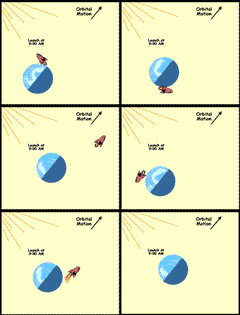
Besides the restricted span of launch dates, there is also a tight limit on the time of day at which Rosetta can leave Earth. Because the Earth rotates, Kourou must be correctly positioned in relation to the direction in which the spacecraft must head off, on the first leg of its interplanetary journey. The daily window is about 20 minutes, during which time the Earth rotates through 5 degrees.
Launch a rocket from a spinning planet!
In May 2003, similar concerns about a launch window will preoccupy the engineers and scientists of ESA's Mars Express mission, at the Baikonur Cosmodrome in Kazakhstan, in the former Soviet Union. There the launcher will be a Soyuz-Fregat rocket. Scientists have always planned to use the especially favourable relative positions of Earth and Mars occurring in mid-2003 (and not repeated until 2020) for Mars Express to have an express flight to the Red Planet.
Opportunities to fly to Mars occur every 26 months, but the travelling distance varies a lot because the orbit of Mars is elliptical, that is, egg-shaped. The 2003 opportunity coincides with a time when the Earth is about to overtake Mars, as the planets orbit around the Sun, and when Mars happens to be in the closest sector of its orbit. The Mars Express launch window opens at 20:41 CET on 23 May 2003 and closes at 17:47 CET on 21 June 2003.
Almost nothing in space stands still with respect to Earth, so ESA's scientists will have to be careful that their craft, Rosetta, leaves Earth at the right time and in the right way. The spacecraft has a long trip ahead.