New glovebox facility heads to Space Station in May Glovebox
by Marshall Flight Center
More articles in ISSUntil now, most experiments on the International Space Station have been in enclosed containers, with few hands-on crew activities. Many new types of experiments will be possible when the Space Shuttle Endeavour delivers a new facility — the Microgravity Science Glovebox, managed by the Marshall Center — to the Station during the STS-111 mission in May.
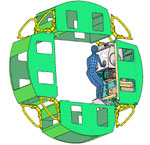 Photo: Microgravity Science Glovebox installed in Space Station (NASA/MSFC)
New Microgravity Glovebox heads to Space Station in May ‘Science in a box’ will let astronauts really get their hands on Space Station experiments
People talk about thinking “outside the box,” but some science experiments aboard the International Space Station will be safer and easier when they are done inside a box.
A glovebox that is.
Until now, many of the Space Station experiments have been in enclosed containers, with few hands-on crew activities. That will change when Space Shuttle Endeavour delivers a new facility — the Microgravity Science Glovebox — to the Space Station in May during the STS-111 mission.
“Without the glovebox, many types of hands-on experiments would be impossible or severely restricted on the Space Station,” said Charles Baugher, project scientist for the glovebox at NASA’s Marshall Space Flight Center in Huntsville, Ala.
The glovebox — a sealed container with built in gloves on its sides and fronts — will enhance the Space Station’s science capabilities by providing a facility where the crew can work safely with experiments that involve fluids, flames, particles and fumes that need to be safely contained. In an Earth-based laboratory, liquids stay in beakers or test tubes. In the near-weightlessness, or microgravity, created as the Station orbits Earth, they float.
Contaminants could get into the cabin air and irritate a crew member’s skin or eyes — or even make them ill. They could damage the Station’s sensitive computer and electrical systems or ruin other experiments.
To make laboratory-style investigations inside the Station possible, engineers and scientists at the Marshall Center collaborated with the European Space Agency to build the glovebox.
During the upcoming four-month Expedition Five on the Station, the glovebox will support the first two materials science experiments to be conducted on the Space Station. These experiments will study materials processes similar to those used to make semiconductors for electronic devices and components used in jet engines.
High-temperature furnaces and toxic materials required for the experiments will be safely contained inside the sealed glovebox work area. Yet by inserting their hands in the gloves, the crew will still be able to change out samples and adjust video for the experiment — two critical hands-on activities crucial to the success of both investigations. The glovebox is hooked up to Station resources like power and computers, so investigators on the ground can still send commands to their experiments and receive data, such as video of samples being melted.
The glovebox facility occupies a floor-to-ceiling rack inside the Destiny laboratory module. It is more than twice as large as gloveboxes flown on the Space Shuttle, and its work volume can hold larger investigations that are about the size of an airline carry-on bag. The work area is waist-high and can slide out to extended positions, making it easier for crew members to work. The side and front ports are 40 centimeters (16 inches) in diameter and are used for setting up and manipulating equipment inside the box.
The Microgravity Science Glovebox is designed to be a fixture of the Station’s Destiny laboratory for the next 10 years. Scientists are developing a steady stream of investigations that take advantage of the glovebox’s capabilities. The glovebox supports relatively low-cost, small investigations from many disciplines including biotechnology, combustion science, fluid physics, fundamental physics and materials science.
“The glovebox allows scientists to test small parts of larger investigations in a microgravity environment, try out equipment on the Station, and do experiments more like they would do them in a laboratory on the ground,” said Baugher.
In exchange for building the glovebox, the European Space Agency will be able to use other facilities inside Destiny until that agency’s Space Station laboratory – the Columbus Orbital Facility – is attached to the Station in a couple of years. The glovebox was built by Bradford Engineering B.V. in The Netherlands.
“We have a long history of working with the Europeans on the glovebox concept,” said Mary Etta Wright, one of the Marshall Center’s lead glovebox engineers. “We built on our successful flights of gloveboxes on the Space Shuttle and the Russian space station Mir.”
Wright does her work in the Microgravity Development Laboratory — a unique Marshall Center facility that helps scientists and engineers prepare investigations from conception to implementation in space. The laboratory has an identical engineering model of the glovebox that was used to test and prepare the first experiments for this flight, and will continue to be used to prepare future investigations.
During the mission, scientists will command and monitor glovebox investigations from a telescience center located at Marshall’s Microgravity Development Laboratory.
“People at the Marshall Center developed gloveboxes to increase the types of experiments we could conduct in space,” said Wright. “We can’t wait to see this facility became a mainstay of laboratory equipment on the Space Station.”