Hydrogen-powered cars, other futuristic products all in a da
by Steve Roy steve.roy@nasa.gov of NASA/Marshall Space Flight Center News Center
More articles in PeopleWhether it's working on International Space Station experiments that may lead to hydrogen-powered, pollution-free cars, or tutoring math and science students, Jeneene Sams brings the benefits of space back to people on Earth.
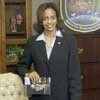 Caption: Jeneene Sams, NASA Space Product Development Program
 "As a market segment manager within NASA's Space Product Development Program, I make it easier for businesses to perform experiments in space," said Sams, a 16-year veteran of the space program at NASA's Marshall Space Flight Center in Huntsville, Ala.
"Companies are willing to pay to do experiments in space because the results can improve their products and ultimately peoples' lives on Earth," she said.
Sams works with two of NASA's 15 Commercial Space Centers -
centers across the country that help companies conduct space research.
One - the Center for Advanced Microgravity Materials Processing at Northeastern University in Boston, Mass. -- has cranked up its furnace on the Space Station three times this year and grown three batches of zeolite crystals. These crystals have the potential to reduce the cost of petroleum and store new types of fuels like hydrogen, which is abundant and pollution-free.
Space Station astronauts inserted the zeolite samples into the furnace, and then scientists on the ground started the furnace. The Space Shuttle brought back to Earth the first batch of crystals in May. Scientists at the Boston center are analyzing the crystals to see if they are bigger and of higher quality, which will make it easier for scientists to learn more about zeolite structures and then tailor them for specific uses.
The third batch of crystals just finished cooking inside the Space Station furnace and was returned to Earth by Space Shuttle Endeavor earlier this month. That Shuttle mission delivered a new batch of samples to the Station for processing.
"I was in the control room listening to the scientist talk to the Space Station crew as they started processing the zeolites," said Sams. "It was rewarding to be a part of this moment after all the frenzy of preparing the furnace and the samples for flight. I felt a real connection to the Station and the astronauts doing the experiment."
Sams also works with the Center for Commercial Applications of Combustion in Space at the Colorado School of Mines in Golden. Scientists at this NASA Commercial Space Center have a partnership with two companies to test a new fire-fighting system that battles blazes with a fine mist, rather than environmentally harmful chemicals. Astronauts are scheduled to test the fire-fighting system later this year on the STS-107 mission of Space Shuttle Columbia to the Space Station - a flight dedicated to space research.
Both commercial experiments that Sams has been sponsoring for flights this year benefit from gathering data in microgravity - the near-weightless environment created as the Station and Shuttle orbit Earth. Prior research with zeolite crystals indicates that better crystals can be grown in microgravity. Combustion is also a process that is easier to study when gravity doesn't interfere. That is why companies want to test their new fire-fighting system in space.
"These companies are willing to invest in space experiments because it is the best place for them to get the data they need to produce the best products," said Sams. "When my two young children are old enough to drive, they may be hopping into cars fueled by hydrogen stored in zeolites. Hydrogen is plentiful, unlike gasoline, and it doesn't pollute. So I can say I played a role in research that helped make the world a better place for my children."
Sams father, Howard Sams, a retired accountant in the Marshall Center's finance department, introduced his daughter to NASA technology at an early age and encouraged her to pursue a technical career.
When she was young, her father and stepmother, Alice, who is a procurement officer at Marshall supporting the Space Transportation Directorate, sometimes took her to work with them.
"I saw the cool things going on at Marshall, and thought NASA could help me make a difference in the world," said Sams.
Sams made frequent visits to see her father in Huntsville, but she lived in Birmingham, Ala., with her mother, Madalyn Rucker and her extended family, including her grandparents, Lena and Isaac Brown. She graduated from John Carroll Catholic High School in Birmingham and earned a bachelor's in mathematics and a minor in computer science from the University of Alabama at Birmingham in 1985.
She later earned a master's in management from the Florida Institute of Technology, attending classes at its Huntsville campus.
In 1986, she joined the Marshall Center as a materials engineer in the Materials, Processes and Manufacturing Department. She helped develop a materials and processes database. Today, this database is still used by NASA materials engineers who design spacecraft -- and even by engineers who design other Earth-based products.
In 1994, NASA selected Sams to participate in the Program Control Development Program - a NASA effort to train technical employees to be managers and expose them to operations at NASA centers
Sams also makes serving the community part of her life. She's a volunteer for projects sponsored by Links Inc., a national organization of African-American professional women with a local chapter in Huntsville. The organization supports and conducts charitable and educational activities beneficial to communities. For example, Sams gives her time to tutor Huntsville school children.
She has participated in NASA programs that encourage students to pursue careers in science and technology at Alabama universities. She was the Marshall Center team coordinator for the North Alabama Sickle Cell Walk-A-Thon, and she served as Marshall Center's executive representative for the 2001 Tennessee Valley Combined Federal Campaign - an annual giving campaign that supports community agencies.
From experiments on the International Space Station to serving the community, Sams believes it's important to pursue endeavors that make a difference in the lives of others.