No shortage of mysteries on Venus
by the European Space Agency
More articles in Solar SystemWhat kind of mysteries and scientific intrigue await the European Space Agency's Venus Express once it has left Earth for its nearest planetary neighbour in 2005? A closer inspection promises to reveal a planet that is hugely different from our own despite a few similarities.
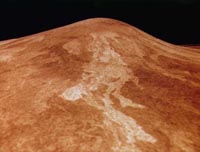 View of the volcano Sif Mons on Venus
Astronomers often call Venus the Earth's twin because both are about the same size and have the same mass. In other ways, however, Venus seems to be an altogether different class of planet. Scientists are keen to take a closer look at this cloudy, mysterious planet. After a 150-day cruise from Earth, Venus Express will manoeuvre into an orbit that loops over the poles of the planet once every 10 -16 hours. What will we see?
The first of many curiosities is the nature of the Venusian magnetic field. It is so weak that particles ejected from the Sun, known as the solar wind, do not go around the planet, as they do at Earth. Instead they continuously strike Venus's upper atmosphere. Scientists want to know more about how this process takes place.
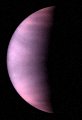 Venus in ultraviolet-light
 What is absorbing ultraviolet light in the Venusian atmosphere?
The atmosphere itself contains plenty of puzzles. Hakan Svedhem, project scientist for Venus Express, says, "The atmosphere of Venus is unique in the Solar System, so understanding it is very important." What we know about our own atmosphere does not much help us understand Venus. How can 'Earth's twin' possess such a different atmosphere? The thick atmosphere creates a greenhouse effect, making Venus hotter than a kitchen oven. This greenhouse effect is definitely worth studying. Another mystery concerns the movement of the atmosphere. About 60 kilometres above the surface, winds race through the cloud cover at almost 400 kilometres per hour. They make the atmosphere rotate, but we do not know how this so-called super-rotation occurs.
The planet's peculiar backward rotation is also a riddle. Venus rotates in the opposite direction to Earth and most of the other planets in the Solar System. It also spins incredibly slowly, taking around 250 Earth days to spin once, as compared to 1 day for Earth. Recent computer models suggest that Venus used to rotate on its axis the same way as Earth did but its heavy atmosphere dragged it to a standstill before causing the present, slow backward rotation.
When we think of the planet's surface, there are many more mysteries. Are there still active volcanoes? Is the entire planet's surface a single solid crust or does it consist of continental plates that float on a partially molten interior, similar to Earth? We know the planet itself is 4 thousand million years old but the entire surface of Venus appears to be 500 million years old! Was the planet resurfaced? If so, how did that happen?
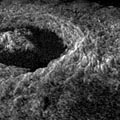 View of the Golubkina crater on Venus
Perhaps the most exciting phenomenon of all is in the atmosphere, just above the super-rotation layer. Here, at about 80 kilometres altitude, something is absorbing ultraviolet wavelengths of light. There is no obvious explanation of these mysterious absorption patches. However, some scientists believe that they could be acid-eating microbes using ultraviolet light in some alien photosynthesis process.
There is a large range of mysteries for Venus Express to investigate. As Svedham says, "This mission will enhance our entire picture of Venus. We will understand it as a planet much more."