Ariane 5
from European Space Agency
More articles in Rockets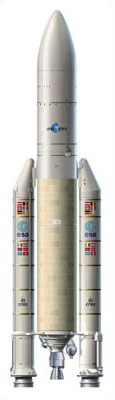
Main Data Ariane 5G
Height up to 52 m
Diameter up to 5.4 m
Liftoff mass* 710 tonnes
Max. payload mass** 5.97 tonnes
Ariane 5 is designed to meet the challenges of the new millennium. It meets several requirements: the ability to launch larger satellites, the increasing use of low orbits for servicing the International Space Station and the need to reduce costs while maintaining a high reliability.
Its first successful launch took place on 30 October 1997 while its first operational flight occurred in December 1999, when it launched ESA’s X-ray Multi-Mirror (XMM). Ariane 5 has proved highly reliable and economic, and has been used to launch satellites for communications, Earth observation and scientific research into geostationary orbits and Sun-synchronous orbits. ESA had to build a new launch site at Europe’s spaceport in Kourou for this new member of the Ariane family as well as facilities to make the solid boosters needed to launch this, the most powerful launcher in the Ariane family.
Ariane 5 can be used for launches into geostationary orbit, medium-Earth orbit and low-Earth orbit, as well as for launches to other planets.
* Double launch
** Includes spacecraft, dual launch system (if used) and adaptor(s)- Launch in GTO