Ariane 4 - from the European Space Agency
by European Space Agency
More articles in Rockets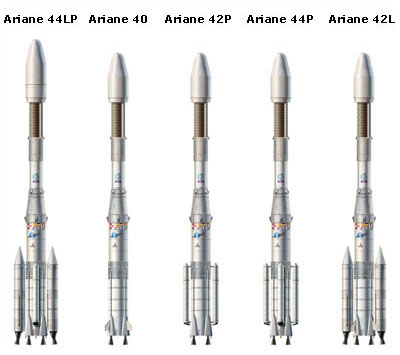 Ariane models
 Ariane 4 launchers
Main Data 42L 44LP 44L
Height up to 58.72 m up to 58.72 up to 58.72
Diameter* 3.8 m 3.8 m 3.8 m
Liftoff mass 362 tonnes 420 tonnes 470 tonnes
Max. payload mass** 3.48 tonnes 4.22 tonnes 4.73 tonnes
Main Data 40 42P 44P
Height up to 58.72 m up to 58.72 m up to 58.72 m
Diameter * 3.8 m 3.8 m 3.8 m
Liftoff mass 245 tonnes 320 tonnes 335 tonnes
Max. payload mass** 2.10 tonnes 2.93 tonnes 3.46 tonnes
Ariane 4 is justly known as the ‘workhorse’ of the Ariane family. Since its first flight on 15 June 1988 it has made over 100 successful launches. The Ariane 4 has proved ideal for launching satellites for communications and Earth observation, as well as for scientific research.
This launcher is extremely versatile. The first stage can hold two or four strap-on boosters, or none at all. This means that it can lift into orbit satellites weighing from 2000 to nearly 4800 kg in GTO, nearly three times as much as the Ariane-3 launcher. Now its role is gradually being taken over by the Ariane-5 launcher and the last Ariane-4 flight is expected to take place in 2003.
Ariane 4 has captured 50% of the market in launching commercial satellites showing that Europe can more than hold its own in the commercial launch market.
* With fairing
** Includes mass of spacecraft, dual launch system (if used) and adaptor(s)- Launch in GTO