Rockets, satellites, planets and solar system explorations, dark matter and black holes. People, science projects, and telescopes discovering the universe.

Launcher
Home
Headlines - Space.com
IMO
ISS
Missions
NAMN
People
Rockets
Satellites
Science Projects
SETI
Solar System
Space Shuttle,
Spaceships

Space Tourism
Stars
Telescopes

NASA Centers
Centers List
Deep Space
Network
Education Sites
Field Centers
Goddard
HEDS: Space Flight
Johnson
Kennedy
Liftoff to Space
Marshall
NASAexplores
Origins Program
Organizations
R&T Reports
Science@NASA
SEDS
Space Camp
SpaceKids
Space Lab: NOAA
Space Library
SpaceLink
SpaceWeather.com
Stennis

Related:
British National Space
Canadian Space Agency
Chabot Space & Science
ISAS
ESA
Feedback
Free Update
Natural Science
Space Adventures
Space Explorers, Inc.
Submissions

Research Sites:
Ames
Calgary ISR
Dryden
DSRI
ESTEC
ETL
Glenn
Hiraiso Solar
Icing Tunnel
IKI
INPE
ISRO
JGR
Langley
MIT
New Wave
NSBRI
SPARC
Texas Space
University of Leicester
USRA
White Sands

For questions concerning this site, contact webmaster.


Find your favorite art:

printfinders.com

When space makes you dizzy:
Landing a spaceship is not a good time for a pilot to feel dizzy.

It's easy to tell which way is up and which way is down...or is it? In the freefall of space travel, there's no pull of gravity to tell your body which way is which. Most astronauts and cosmonauts experience some motion sickness when they first arrive in orbit. NASA is studying why.

Collectology - the collecting of science

Download sound files of the sun from Stanford's Solar Center: The Singing Sun.

Go to theBBC SPACE Science Homepage & Weather Page
for space events and forecasts.


Send an Internet Greeting Card
Enter Card ID Number to
Pickup Your Greeting Card


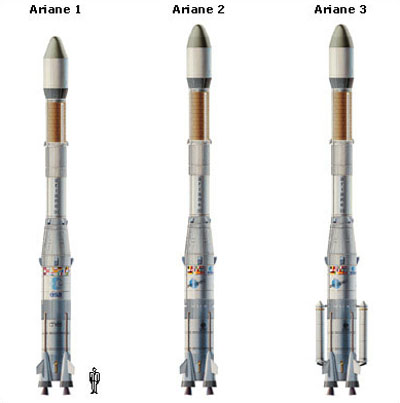
Ariane 1, 2, 3 from the European Space Agency


Main Data Ariane 1 Ariane 2 Ariane 3
Height 47.4 m 49 m 49 m
Diameter 3.8 m 3.8 m 3.8 m
Liftoff mass 210 tonnes 219 tonnes 237 tonnes
Max. payload mass* 1.83 tonnes 2.27 tonnes 2.65 tonnes
 
The first Ariane launcher blasted into the sky on Christmas Eve, 1979. An early Christmas present for the thousands of workers throughout Europe and at Europe’s spaceport in Kourou who were involved in its development and production.

Ariane 1 was designed primarily to put two telecommunications satellites at a time into orbit, thus reducing costs. As the size of the satellites grew Ariane 1 began to give way to the more powerful Ariane-2 and Ariane-3 launchers.


Altogether, eleven successful Ariane-1 launches took place between 1979 and 1986, and five successful Ariane-2 flights between 1987 and 1989. Ariane 3 made a record 11 flights from 1984 to 1989, all of which were successful.

All three launchers were slightly different. The first and third stages of Ariane 2 and Ariane 3 were longer than those of Ariane 1, while Ariane 3 had strap-on boosters containing liquid or solid propellant, making it the most flexible and powerful of the three launchers, able to launch a payload of 1.7 tonnes.

* Includes mass of spacecraft, dual launch system (if used) and adaptor(s)- Launch in GTO


Please visit our
affiliate partners that
keeps our site up.


Home   |   Free Update   |   Headlines - Space.com   |   Submissions   |   Contact Us

Website is powered by FRSHOSTING.com