'Ariane 10 tonnes': added lift capability for Europe
by the European Space Agency
More articles in Rockets27 November 2002
ESA INFO 9-2002. To meet market demand, Europe is about to launch, on 28 November, the latest version of Ariane 5, capable of placing up to 10 tonnes of payload in geostationary transfer orbit. This new development is the key to maintaining Europe's competitiveness in the commercial space transport sector and securing its continued independent access to space.
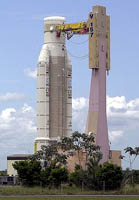 Flight 157 - Ariane 5 moves to the final assembly facilty
 Like the 1979 Ariane 1, forerunner of Ariane 2, 3 and 4, Ariane 5 was conceived from the outset as the first in a new family of launchers that would assure Europe of a guaranteed, competitive means of access to space. So, in October 1995, even before the new launcher's first flight, the ESA member states decided, at a Council meeting at ministerial level in Toulouse, to start work on an evolved version of Ariane 5 with increased lift capability.
Commercial space transport, which represents most of the Ariane launchers' activity, depends to a large extent on developments in the satellite market. During the 1990s, that market saw a sharp increase in the power and capacity (and therefore mass) of geostationary telecommunications satellites, which alone account for more than 95% of the commercial market. In the course of 10 years, large satellites increased in mass from 2.5 to almost 5 tonnes. Since 2000, orders have been placed for satellites weighing 6 tonnes or more.
At the same time, the competitive environment has changed. Orders for new satellites have slowed, the communications sector is going through a phase of consolidation and rationalisation, and many more launchers are now operating in competition with Ariane, resulting in overcapacity.
A response to new market demand
In order to maintain a competitive edge, the Ariane system has been geared since the beginning of the 1980s to dual launches of geostationary satellites. The new market conditions have made this even more imperative. In 1995 ESA commissioned studies and predevelopment work to increase Ariane 5's lift capability further, and in May 1999 the ESA Council meeting at ministerial level approved a new plan to improve the Ariane 5 launcher so as to achieve the aim of lifting 10 tonnes into geostationary transfer orbit in 2002 and 12 tonnes by 2006. ESA has delegated the technical management of these Ariane 5 follow-on development programmes, like the earlier ones, to the French space agency, CNES, with EADS-LV as industrial architect. Arianespace will continue to be responsible for the marketing side.
This new lift capability, and the strategy for achieving it while at the same time reducing launcher production costs, means that Ariane 5 will be able to launch almost all satellites on the market, from the largest to the smallest, in pairs. Also, its fairing, 5.4 m in diameter, can accommodate the most bulky satellites.
This answer to pairing constraints is accompanied by greater flexibility regarding occupancy. The launcher has been designed to achieve a very substantial reduction in the cost per kg to orbit, so that it will still be competitive even when carrying two satellites that together weigh less than 10 tonnes.
In practice, as a result of these improvements, Ariane 5 will have a powerful and at the same time standardised configuration enabling it to take satellites on board in pairs as they arrive in Kourou.
All these features will secure the success of Arianespace's commercial range in years to come.
Tried and tested architecture
The first Ariane 5 with a lift capability of 10 tonnes will be used on Flight 157, Ariane 5’s 14th launch and 11th commercial mission since it was commissioned by Arianespace in 1999. On 28 November, lifting off from Kourou in French Guiana, it will launch two satellites, the Hot BirdTM 7 communication satellite for Eutelsat, and the STENTOR space telecoms technology satellite for CNES.
The “Ariane 10 tonnes” launcher or Ariane 5 ECA, to give it its official name, has the same general architecture as the generic Ariane 5 launcher, with two solid boosters to lift it off the launch pad, a cryogenic main stage to do most of the work of getting into orbit, and an upper stage to place the satellites in the target orbit, in most cases a geostationary transfer orbit of up to 36 000 km from which their onboard propulsion systems will take them into their final orbit.
To raise the lift capability from 5.9 tonnes to 10 tonnes for a dual launch, most of these features have been “beefed-up” to increase their performance.
“Beefed-up” propulsion
The solid boosters - made by Europropulsion (Italy, France) under the prime contractorship of EADS-LV - each comprise three segments and the smallest of these now carries 10%, or approximately 2.5 tonnes, more propellant. Because of its form, this segment is the one which burns most quickly and gives the launcher its initial thrust. The extra propellant provides an additional 50 tonnes of thrust in the first 20 seconds following lift-off. So, between them, the twin boosters deliver thrust of 1 400 tonnes, or 10 times that delivered by the engine of the central stage. That means 400 kg more payload. Also, these boosters are equipped with a new nozzle, which has fewer parts and so is easier and cheaper to produce.
Several improvements have also been made to the main stage, developed by EADS-LV. Its Vulcain cryogenic engine, produced by Snecma (France), has been modified to increase its thrust by 20%, to 137 tonnes. The new version, Vulcain 2, burns a mixture with 20% more liquid oxygen under slightly higher pressure than the previous version. As a result of this change in the mixture of propellants, FiatAvio (Italy) has had to develop a new oxygen turbopump, capable of 13 000 rpm and delivering pressure of 161 bar. It has also been necessary to increase the capacity of the liquid oxygen tank in this stage by 15 tonnes. This has been achieved, without altering the structure of the stage, by lowering the bulkhead between the liquid oxygen and hydrogen tanks by 640mm.
Another improvement in Vulcain 2 is a new nozzle divergent, manufactured by Volvo Aero (Sweden), which enables the emissions from the turbopumps to be reinjected into the main system and improves the engine's performance at high altitudes.
All in all, Vulcain 2 alone provides an additional GTO lift capability of 1 300 kg.
The legacy of Ariane 4
The most important new feature of “Ariane 10 tonnes” is in the upper stage. The storable propellant stage (EPS) has been replaced by a cryogenic version (ESC-A) carrying 14.6 tonnes of liquid oxygen and hydrogen. Produced in Bremen under the prime contractorship of Astrium (Germany), it makes extensive use of tried and tested technologies, including the liquid oxygen tank, thrust frame and propulsion unit used in the third stage of Ariane 4, together with its HM-7B engine, supplied by Snecma. The liquid hydrogen tank employs the technologies developed for the tank housed in the main stage. The only new feature is the dome-shaped bulkhead, which holds the liquid oxygen tank.
The stage rests on a composite cylindrical section 5.4 m in diameter and 2.8 m high, produced by EADS CASA Espacio (Spain).
The ESC-A is the key improvement to Ariane 5. It alone accounts for 60% of the increase in performance compared with the preceding launcher in the series, with almost no change in production costs. It is also responsible for deploying satellites with maximum precision so as to ensure that they have an optimum operational life.
A rigorous qualification programme
All these modifications to the Ariane 5 launcher have been subjected to rigorous qualification procedures under the ESA development programmes and the Ariane Research and Technology Accompaniment programme, ARTA, which is also managed by ESA and funded by the European governments.
The increased propellant charge carried by the boosters and their new nozzle were qualified in two full-scale hot tests conducted at Kourou in May 2000 and November 2001. And the Vulcain 2 engine has undergone over 130 test-stand firings at Vernon, in Normandy, and Lampoldshausen, in Baden-Würtemberg, accumulating more than 50 000 seconds of operating time, equivalent to about 100 flights.
The ESC-A stage has been subjected to exhaustive qualification with dynamic and vibration tests conducted at the IABG Centre at Ottobrunn (Germany). The HM-7B engine, although it has already flown more than 130 missions, has undergone its own validation test campaign to ensure that it functions satisfactorily in Ariane 5 flight conditions and, in particular, with 200 seconds more burn time. An operational test campaign has also been conducted at Kourou on a complete stage, to check the procedures and interfaces required for filling and activating the stage on the launch site, including the use of new retractable cryogenic arms mounted on the mobile launch table mast.
Objective: re-ignition
“Ariane 10 tonnes” will be the standard version of the Ariane 5 launcher for the next few years. However, its successor is already being planned under the Ariane 5 Plus programme on which decisions were taken at the ESA Council meetings at ministerial level held in Brussels in 1999 and Edinburgh in 2001. Ariane 5's development potential is by no means exhausted and the next version is set to increase its GTO lift capability to 12 tonnes.
A new and more powerful upper stage is now being worked on. It will be equipped with a new engine, the Vinci, already under development, capable of delivering three times as much thrust and performing re-ignition and ballistic phases. The re-ignition capability will give Ariane 5 added flexibility to meet emerging market demand for other orbits or complex deployments such as placing constellation clusters in medium Earth orbit.
For further information, please contact:
ESA Media Relations Service
Tel: +33(0)1.53.69.7155
Fax: +33(0)1.53.69.7690