First Confirmed Capture into Earth Orbit Is Likely Apollo Ro
by Jet Propulsion Laboratory
More articles in RocketsNASA scientists have confirmed the first known capture of an object into Earth orbit from a Sun-centered orbit, thanks to continuing observations of what is most likely the long-lost third stage of a 1969 rocket to the Moon.
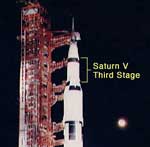 Apollo 12 on launchpad, November 1969
 "Last week we didn't know for sure that it had been captured, and now there's no doubt that it was captured in April of this year," said Dr. Paul Chodas of the Near-Earth Object Program Office at NASA's Jet Propulsion Laboratory, Pasadena, Calif. "What's more, we are virtually certain that it originally escaped Earth orbit in March 1971 and that it will escape again next June. It's only a temporary visitor."
The object, named J002E3, was discovered Sept. 3 by Canadian amateur astronomer Bill Yeung, observing from El Centro, Calif. Increasingly precise orbital calculations made possible from a second week of positional observations have nearly ruled out any chance the object will hit the Moon or enter Earth's atmosphere before it departs Earth orbit, Chodas said. Calculations made about a week after the discovery left higher impact possibilities, but now the chances of impact are less than 1 percent at either the Moon or Earth, and a third week of observations will likely push the odds to zero. The object is too small to be considered hazardous, in any case.
More than 100 measurements of the object's position have now been reported from more than a dozen amateur astronomers, said JPL's Dr. Steven Chesley. The two weeks of movement tracked by those observations make up about a sixth of one orbit around Earth. Scientists can extrapolate the object's path for years into the future and years into the past from that short arc. "The observations coming in are from a loosely organized network of dedicated amateur observers. Their data have been vital in determining this object's past and future paths," Chesley said.
The object escaped from Earth orbit in March 1971, Chodas said. That fits its most likely identity as the third stage of the Saturn rocket that took Apollo 12 astronauts to the Moon in November 1969. The 18-meter-long (60-foot-long) third stage was last seen in an elongated 43-day orbit around Earth, not much different from J002E3's current orbit. It probably completed nine or 10 Earth orbits, then swung far enough toward the Sun to be pulled into a Sun-centered orbit, he said. The transition happened through a special "portal" located at the L1 Lagrangian point, where the gravitational pulls of the Sun and Earth are approximately equal.
Analysis this week by researchers from the University of Arizona, Tucson, and the Massachusetts Institute of Technology, Cambridge, suggests that J002E3's surface is white paint rather than more asteroid-like material. If it is not from the Apollo 12 rocket, some less likely possibilities are one of the four 7-meter-long (22-foot-long) panels that enclosed lunar modules from six Apollo missions or rocket stages from Soviet or U.S. unmanned lunar missions. Those are less likely because they seem too small to match the object's observed brightness, and they are not known to have been left in orbits that could have escaped Earth. Additional observations in coming weeks may pin down the identification.
After J002E3 escaped Earth's gravity in 1971, it raced Earth in circles around the Sun, but it had an inner lane, so it completed 33 solar orbits in the time it took Earth to complete 31. In 1986, the object lapped Earth on the inside, too far away to be snagged by Earth's gravity. This year, it was about to lap Earth again but passed too close to the L1 portal and Earth captured it.
The transition between Earth-centered dynamics and Sun-centered dynamics has been understood theoretically for years and has been used for designing orbits of some spacecraft, but this is the first time a capture into Earth orbit has been confirmed, Chodas said. Comet Shoemaker-Levy 9, which struck Jupiter in 1994, made this kind of transition into Jupiter's orbit several decades earlier. NASA's Genesis spacecraft, currently collecting samples of solar-wind material near the L1 point, will use a similar maneuver for a low-energy return to Earth with the samples in 2004.
Earth won't have seen the last of J002E3 when this peripatetic bit of space junk escapes after its sixth orbit in mid-2003. It will shift from solar orbit to Earth orbit again in decades ahead. "This type of orbit can't last very long," Chodas said. "That's one reason it would be very unlikely to find an asteroid with an orbit like this." Within several thousand years, the object will likely end its travels by hitting the Moon or Earth. That is not cause for concern, though. Five rocket stages like the Apollo 12 third stage were crashed into the Moon intentionally as part of seismic research, and several others harmlessly disintegrated when they re-entered Earth's atmosphere.